
Upgrade Your EKS Clusters Before April 1st Or Pay The Price

Amazon Elastic Kubernetes Service (Amazon EKS) has recently announced extended support for Kubernetes versions, providing an additional 12 months of support for Kubernetes minor versions. However, starting from April 2024, there will be a cost of $0.60 per EKS cluster per hour for extended support. This cost covers the Kubernetes control plane, while AWS resources used for worker nodes or cluster functions will be billed separately. It is important to note that extended support is available for Kubernetes versions 1.23 and higher. To avoid facing a hefty bill, it is crucial to start planning and testing the upgrades now. If your team lacks the necessary bandwidth or infrastructure expertise, reach out to SlickFinch today. As Kubernetes experts, we can handle the task of preparing and executing the required work for you, ensuring a seamless transition.
Upgrade Your EKS Clusters Before April 1st Or Pay The Price

Upgrade Your EKS Clusters Before April 1st Or Pay The Price

Background

Amazon Elastic Kubernetes Service (Amazon EKS) has recently announced extended support for Kubernetes versions, providing an additional 12 months of support for Kubernetes minor versions. This extended support is available for Kubernetes versions 1.23 and higher. However, it is important to note that starting from April 1st, 2024, there will be pricing implications for running older versions of Kubernetes on EKS.

Upgrade Your EKS Clusters Before April 1st Or Pay The Price

Extended Support for Kubernetes versions

The extended support offered by Amazon EKS ensures that Kubernetes minor versions receive an additional 12 months of support beyond the standard support duration. This allows users to have more time to upgrade their Kubernetes versions while still receiving necessary support.

Pricing for Extended Support

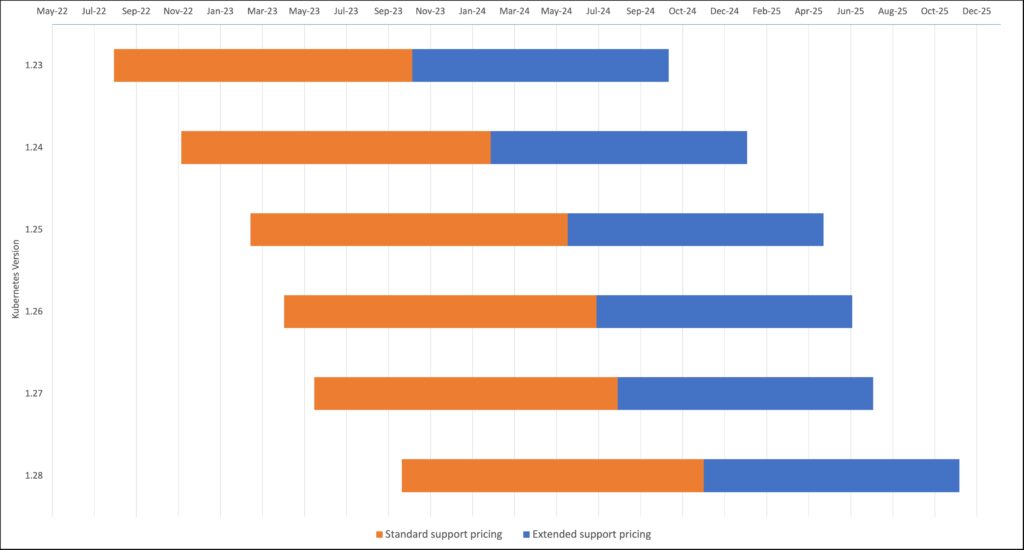
Starting from April 1st, 2024, there will be a cost associated with running EKS clusters on Kubernetes versions in extended support. The pricing for extended support will be set at $0.60 per cluster per hour. It is important to note that this pricing covers the Kubernetes control plane, while AWS resources used for worker nodes or cluster functions are billed separately.

Availability of Extended Support

Extended support is available for Kubernetes versions 1.23 and higher. This means that EKS clusters running on older Kubernetes versions will no longer be eligible for extended support. It is crucial for users to upgrade their clusters to newer Kubernetes versions to continue receiving support and avoid increased costs.

Standard Support and Extended Support Durations

Standard support offered by Amazon EKS lasts for 14 months for each Kubernetes minor version. However, the extended support duration provides an additional 12 months of support, allowing users more time to plan and execute their upgrades. It is essential to keep track of the support dates and pricing for different Kubernetes versions, which can be found in the Amazon EKS version calendar.

Billing Based on Kubernetes Version

The billing for EKS clusters is dependent on the version of Kubernetes running on the cluster. Running clusters on versions in standard support will not incur any additional costs beyond the standard EKS pricing. However, starting from April 1st, 2024, clusters running on versions in extended support will be charged at the increased rate of $0.60 per cluster per hour.

Consequences of Running Old Versions on EKS

Impact of Not Upgrading

Not upgrading your EKS clusters to newer Kubernetes versions can have various negative impacts on your infrastructure apart from this new increased cost. Running on older Kubernetes versions means missing out on the latest features, bug fixes, and security patches provided by newer versions. This can leave your infrastructure vulnerable to potential security threats and may hinder your ability to take advantage of the latest advancements in Kubernetes technology.

Planning and Testing Upgrades

Importance of Planning and Testing

To ensure a smooth and successful upgrade process, planning and testing are of utmost importance. Upgrading EKS clusters involves various considerations, including compatibility with newer versions and potential impact on applications and workloads. It is vital to invest time and effort in planning and testing to minimize disruption and ensure a seamless transition.

Identifying the Current Kubernetes Version

Before proceeding with the upgrade process, it is important to identify the current Kubernetes version running on your EKS clusters. This information will serve as a starting point for determining the necessary steps and compatibility considerations for upgrading to newer versions. Amazon EKS provides tools and documentation to help you easily identify the version of Kubernetes running on your clusters.

Checking Compatibility with Newer Versions

Once you have identified the current Kubernetes version, it is essential to check its compatibility with newer versions. Not all applications and workloads may be compatible with the latest Kubernetes versions, and certain modifications or adjustments may be required. Consider reaching out to application owners and stakeholders to ensure seamless compatibility during the upgrade process.

Creating an Upgrade Timeline

Creating a detailed upgrade timeline is crucial for a well-executed upgrade process. This timeline should include steps such as backing up critical data, verifying compatibility with dependencies, and scheduling maintenance windows for minimal disruption. By mapping out the process in advance, you can streamline the upgrade and minimize downtime for your applications and services.

Testing the Upgrade Process

Before performing the actual upgrade on production clusters, it is highly recommended to thoroughly test the upgrade process in a non-production environment. Testing can help identify any potential issues or conflicts that may arise during the upgrade and allow you to address them proactively. By running comprehensive tests, you can validate the compatibility of your applications and ensure a smooth transition to the new Kubernetes version.

Seeking Assistance from SlickFinch

Lack of Bandwidth or Infrastructure Team

Upgrading EKS clusters and managing the associated tasks may require significant bandwidth and expertise. If your organization lacks the necessary resources or infrastructure team to handle the upgrade process, it is advisable to seek assistance from external experts.

Benefits of Outsourcing to SlickFinch

SlickFinch specializes in Kubernetes expertise and can provide valuable assistance in planning, executing, and managing the upgrade process for your EKS clusters. By outsourcing these tasks to SlickFinch, you can save time, ensure a smooth transition, and alleviate the burden on your internal resources.

Contact Information

If you need help with your EKS cluster upgrades, you can contact us to discuss your needs in more detail.

Conclusion

Upgrading your EKS clusters to newer Kubernetes versions before April 1st, 2024, is crucial to avoid increased costs associated with extended support. Failing to upgrade can lead to unexpected financial implications and leave your infrastructure vulnerable to security threats. By planning and testing the upgrade process now, you can ensure a smooth transition and take advantage of the latest features and security patches. If your organization lacks the necessary bandwidth or infrastructure team, consider reaching out to SlickFinch for expert assistance in managing the upgrade process. Act now to protect your organization from unnecessary costs and stay up to date with the latest Kubernetes advancements.

Related Posts

2026 devops trends

2026 DevOps, Platform Engineering, and Cloud Infrastructure Trends: A Strategic Guide for CTOs

Key Takeaways The year 2026 marks a pivotal shift in the technology landscape, moving from the complexity of pure DevOps to a focus on efficiency, control, and strategic AI integration. For CTOs and technology decision-makers, the following trends are non-negotiable for maintaining a competitive edge: • AI-Augmented Platforms: Internal Developer Platforms (IDPs) will integrate AI agents to manage complex infrastructure autonomously, shifting the human role from architect to strategist. • Financial Governance: FinOps will evolve from reactive reporting to proactive, pre-deployment cost gates, making unit economics a core part of the CI/CD pipeline. • Security by Design: The rise of AI-generated code necessitates platforms that act as a safety net, enforcing “governance-by-default” to make non-compliant deployments technologically impossible. • Cloud Sovereignty: Geopolitical pressures will accelerate the trend of “Geopatriation,” driving a strategic move toward sovereign and regional cloud solutions, secured by Confidential Computing. Introduction: The New Mandate for Strategic Efficiency For the past decade, the mantra of DevOps has driven unprecedented speed in software delivery. However, as organizations scaled, this success introduced a new challenge: the “DevOps tax.” Developers, increasingly burdened with managing complex infrastructure, security, and observability tools, found their cognitive load soaring, leading to reduced feature velocity and increased operational risk . The outlook for 2026 is defined by a strategic response to this complexity. The focus shifts from simply doing DevOps to enabling it at scale through specialized tooling and automation. This is the year where Platform Engineering and Artificial Intelligence (AI) converge to deliver true strategic efficiency, providing CTOs with the control, security, and cost predictability their boards demand. I. The Platform as the Engine of AI-Driven Velocity The most significant trend shaping 2026 is the maturation of the Internal Developer Platform (IDP) into an AI-augmented system. This evolution is driven by the need to safely integrate generative AI into the development lifecycle while simultaneously reducing the cognitive burden on engineering teams. 1. Agentic Infrastructure and AI-Native Development AI is graduating from a coding assistant to a first-class citizen within the infrastructure stack. Gartner predicts that by 2030, AI-native development platforms will allow 80% of organizations to evolve large software engineering teams into smaller, more nimble units augmented by AI . This is enabled by: • Agentic Infrastructure: Mature IDPs will treat AI agents like any other user, complete with Role-Based Access Control (RBAC) and resource quotas. These agents will move beyond simple tasks to autonomously orchestrate deployments, negotiate resource allocation, and even implement architectural changes based on real-time observation . • Domain-Specific Language Models (DSLMs): General-purpose Large Language Models (LLMs) are insufficient for complex, regulated enterprise environments. By 2028, over half of the GenAI models used by enterprises will be domain-specific, trained on proprietary data to ensure higher accuracy, reliability, and compliance for targeted business needs . SlickFinch Strategic Advantage: Building an AI-ready platform requires a robust foundation. SlickFinch specializes in CI/CD Automation and World-Class Kubernetes Adoption, providing the standardized, secure base layer necessary for integrating AI agents. Our expertise ensures that your platform is not just automated, but intelligently orchestrated, allowing your smaller, AI-augmented teams to focus purely on business logic. 2. The Platform as a Safety Net for AI-Generated Code The rapid adoption of AI for code generation—often termed “vibe coding”—introduces non-deterministic risks. An LLM might generate infrastructure code that is syntactically correct but functionally insecure or non-compliant. In 2026, the IDP becomes the essential safety net. Platforms will serve as the primary reviewer and auto-remediator for AI-generated code, preventing security vulnerabilities and configuration errors before they reach production. This shift is crucial for maintaining operational stability in an era of accelerated development . II. Financial and Governance Imperatives: From Reactive to Preemptive For CTOs, the conversation around technology has irrevocably shifted from “how fast can we go?” to “how efficiently and securely can we operate?” The trends for 2026 reflect a strong focus on financial accountability and preemptive governance. 3. FinOps Becomes a Hard Requirement Cloud cost management is moving from a post-mortem analysis to a preventive control. FinOps will transition from reactive dashboards to proactive, pre-deployment cost gates. Platforms will implement controls that block services exceeding predefined unit-economic thresholds, baking financial guardrails directly into the development lifecycle . This includes managing the new frontier of compute expense: AI-specific budgets for token and inference costs. 4. Governance-by-Default and Preemptive Security The industry is moving beyond the “shift left” security model to “governance-by-default.” This means injecting robust controls directly at the infrastructure layer, making non-compliant deployments technologically impossible . This is complemented by the rise of Preemptive Cybersecurity, where organizations shift from reactive defense to proactive protection using AI-powered SecOps and programmatic denial and deception. Gartner forecasts that by 2030, preemptive solutions will account for half of all security spending . SlickFinch Strategic Advantage: SlickFinch’s deep expertise in Infrastructure as Code (IaC), particularly with Terraform and OpenTofu, is directly aligned with these trends. We help organizations implement Policy-as-Code and cost-aware architecture, ensuring that security and financial guardrails are enforced automatically, providing the control and predictability that decision-makers require. III. The Evolving Cloud Landscape: Sovereignty and Confidentiality The cloud infrastructure conversation in 2026 is increasingly influenced by global politics and the need for absolute data privacy. The era of simply defaulting to a single hyperscaler is over. 5. Geopatriation and the Rise of Sovereign Cloud Geopolitical instability is driving a strategic trend called Geopatriation, where organizations move data and applications out of global public clouds and into local options, such as sovereign clouds or regional providers . This is no longer limited to highly regulated sectors like banking; it affects any organization concerned with data residency, compliance, and governance. Gartner predicts that by 2030, over 75% of European and Middle Eastern enterprises will geopatriate their virtual workloads . 6. Confidential Computing as the Privacy Baseline To address the trust gap in multi-cloud and sovereign environments, Confidential Computing is becoming a baseline requirement. This technology isolates workloads inside hardware-based Trusted Execution Environments (TEEs), keeping data and applications private even from the infrastructure owner or

Read More »

Kubernetes v1.35 Preview: Workload Aware Scheduling Could Be A Game Changer

Kubernetes v1.35 introduces Workload Aware Scheduling, potentially transforming AI/ML and HPC workloads by addressing inefficiencies in traditional pod-by-pod scheduling. The new Workload API offers structured multi-pod application support, promising better resource utilization and predictability for distributed jobs. This change could redefine Kubernetes for complex applications…

Read More »
ingress nginx retirement

Ingress NGINX Retirement Announcement: Kubecon Atlanta 2025 News

KubeCon Atlanta 2025 highlights the retirement of Ingress NGINX by March 2026, urging users to migrate to Gateway API or alternatives. The shift promises improved routing, security, and multi-tenancy, but requires immediate action from users to ensure secure, supported operations in Kubernetes environments…

Read More »

Share Article

Set Your Business Up to Soar with our DevOps Consulting Services

Don’t let DevOps stand in the way of your success. Let’s explore how SlickFinch can help you achieve your goals.