
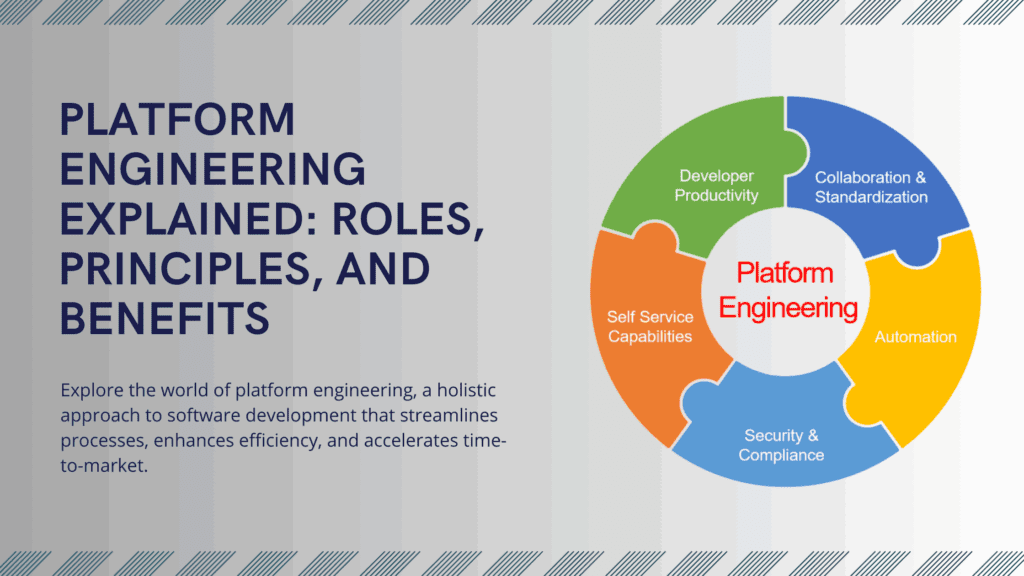
Platform engineering is an emerging field that fills the gap between development and operations. It provides standardized tools and workflows that enable self-service capabilities.
It is important to think of your platform as a product and your developers as customers. This product mindset is crucial for successful platform engineering. It ensures that your platform is adopted and used effectively.
Organizations should strive to reduce the cognitive load for developers. This can be achieved through self-service capabilities and golden paths that standardize development workflows.
Automation is a key component of effective platform engineering. In fact, 78% of high-performing engineering organizations automate over 75% of their infrastructure processes.
Platform engineering offers measurable benefits. According to industry benchmarks, it leads to 63% faster deployment frequencies, a 47% reduction in lead time for changes, and a 64% decrease in change failure rates.
Platform engineering is a fundamental shift in how organizations approach software development infrastructure. It was born out of the challenges that many teams faced when implementing DevOps at scale. Platform engineering provides the structure and standardization needed to truly enable developer productivity while maintaining operational excellence.
With the increasing complexity of today’s technical world, developers are constantly bombarded with the task of keeping up with cloud technologies, security needs, and operational best practices. The solution to this problem is platform engineering, which creates custom internal platforms designed to simplify complexity and provide consistent and reliable ways to production.
Summary of the Article
This complete guide will take you through platform engineering, starting from the basics to the best practices for implementation. We will look at how it is different from the usual DevOps, identify the main components of successful platform engineering initiatives, and provide strategies that you can act on for building effective platform teams. Whether you are just starting your platform engineering journey or looking to improve the existing practices, this article will provide practical insights to improve your organization’s approach to development infrastructure.
Understanding Platform Engineering and Its Importance
Platform engineering is all about creating and designing workflows and toolchains that allow software engineering organizations to self-serve. It involves building standardized, automated infrastructure that developers can use without having to be experts in operations. Instead of requiring developers to learn how to manage infrastructure or deploy applications on their own, platform engineering teams create internal platforms. These platforms offer these capabilities through user-friendly interfaces, often leveraging concepts like platform architecture to ensure efficient operations.
Platform engineering is essentially about making life easier for developers. It provides them with standardized tools, workflows, and environments that make their work more efficient and consistent. This means they can concentrate on creating features instead of having to deal with infrastructure issues. In other words, platform engineers are creating a product (the platform) and their main customers are developers.
When you look at the effects, the importance of platform engineering comes into focus. Businesses that use effective platform engineering techniques have reported deployment frequencies that are up to 63% faster, a 47% decrease in the time it takes to make changes, and a 64% reduction in the rate of change failure. These improvements are directly related to business value because they speed up time-to-market and improve product quality.
How Platform Engineering and DevOps Differ in Crucial Ways
Even though platform engineering has its roots in DevOps principles, the two methods are not the same. DevOps is all about culture, processes, and removing barriers between development and operations teams. Its main goal is to share responsibility for the entire software lifecycle. On the other hand, platform engineering recognizes the unique nature of infrastructure work and forms dedicated teams to create tools that make DevOps practices available to all developers.
From DevOps to Platform Engineering: The Evolution
DevOps came into existence as a movement to eradicate the conventional boundaries between development and operations teams. The objective was to involve developers in operations and vice versa, creating a shared responsibility for software delivery. However, as organizations grew in size, many found that the “everyone does DevOps” approach resulted in inconsistent implementations, knowledge gaps, and inefficiencies as developers spent more and more time on operational tasks.
Platform engineering was born out of the need to address these issues. Instead of forcing all developers to become experts in operations, platform engineering teams centralize this knowledge and transform it into user-friendly, self-service tools. This shift is a sign of the DevOps philosophy growing up—keeping the aim of quicker delivery and mutual responsibility, while acknowledging the necessity for specialization and standardization.
How They Work Together
Platform engineering doesn’t take the place of DevOps—it makes it better. DevOps gives the cultural base and philosophical method that highlights teamwork, automation, and continuous enhancement. Platform engineering gives the practical application that makes those values scalable across big organizations.
The most effective businesses are those that combine both DevOps culture and platform engineering. They maintain the shared responsibility and continuous improvement of DevOps while using platform engineering to create standardized tools and processes that all developers can use. This combination enables teams to maintain the agility of DevOps while also benefiting from the efficiency and consistency of platform engineering.
Key Elements of a Successful Platform Engineering Practice
Platform engineering success isn’t just about the right tools. It’s about building a holistic system that helps developers throughout the software development lifecycle. The foundation of successful platform engineering practices is built on several key elements. These components work together to create an ecosystem that balances developer independence with organizational governance. This allows for innovation while maintaining necessary controls.
What is an Internal Developer Platform?
At the heart of platform engineering is the Internal Developer Platform (IDP). This is a unified collection of tools, services, and processes that developers use to build, test, and deploy software. A good IDP will hide the complexity of the infrastructure, giving developers simple interfaces to carry out complex operations. Instead of forcing developers to understand Kubernetes configuration files or the specifics of a cloud provider, an IDP offers intuitive interfaces that take care of these details out of sight.
Usually, IDPs come with features for provisioning environments, deploying applications, monitoring, and security scanning. They often offer interfaces based on UI for occasional users and tools based on API/CLI for power users and automation. The best IDPs manage to offer sufficient abstraction to simplify complex tasks while still providing the necessary transparency and control.
Self-Service Features
Self-service features are the backbone of effective platform engineering. They allow developers to allocate resources, launch applications, and resolve problems without needing to involve operations teams directly. This significantly cuts down on bottlenecks and speeds up delivery. Good self-service features merge well-crafted interfaces with strong automation to make complicated operations available through easy interactions.
For self-service to be successful, it’s essential to find the right mix of flexibility and governance. Platforms need to provide enough restrictions to ensure compliance and security, but also give developers enough room to be creative. This often means creating templates and configuration options that allow for customization within set limits, rather than inflexible systems that require developers to use a one-size-fits-all solution.
Golden Paths
Golden paths, also known as paved roads, are standardized workflows that guide developers through common processes such as setting up new services, implementing security controls, or deploying applications. These paths are the recommended, well-supported routes for accomplishing tasks within an organization. When developers follow golden paths, they benefit from built-in best practices, pre-approved tooling, and streamlined processes that have been vetted by platform teams.
Crucially, golden paths are not strict rules, they are the easiest route to take. Developers are still allowed to go off the beaten path when they need to, but the golden path should be so easy and well-supported that most choose to stick to it. This method naturally encourages standardization without placing heavy restrictions that could kill creativity or force solutions that don’t fit.
Infrastructure Designed with APIs in Mind
When we talk about infrastructure designed with APIs in mind, we’re referring to a design philosophy where all platform capabilities are created to be programmatically accessible through well-defined, documented interfaces. This is a great approach because it allows for automation, integration with other tools, and customization to meet the specific needs of different teams. While user interfaces are important (especially for those who only use the platform occasionally), APIs are what allow platform capabilities to be incorporated into automated workflows, custom tools, and third-party integrations.
API-first in practice means that every platform capability, from provisioning the environment to deployment to monitoring, should be accessible through consistent APIs with clear documentation and versioning. These APIs form the foundation on which both the platform team and the developer teams can build automation, integrations, and custom workflows tailored to their specific needs.
Monitoring and Feedback
For platform engineering to be effective, the platform and the applications it supports must be thoroughly monitored. This includes monitoring system performance, tracking how the platform is adopted and used, and gathering feedback from developers. This information allows platform teams to identify bottlenecks, understand what developers need, and continuously improve what they offer.
Top performing platform teams make sure to create official channels for feedback with their developer users. This typically involves regular user research, satisfaction surveys, and usage analytics to get a better understanding of how developers are using the platform. These insights help shape the future of the platform, making sure that investments are focused on the features that bring the most value to development teams.
5 Indicators That Your Company Requires Platform Engineering
While not every company needs a formal platform engineering practice, there are several common problems that suggest your teams could benefit from this method. Identifying these indicators early on allows companies to tackle inefficiencies head-on before they have a substantial effect on productivity and business results.
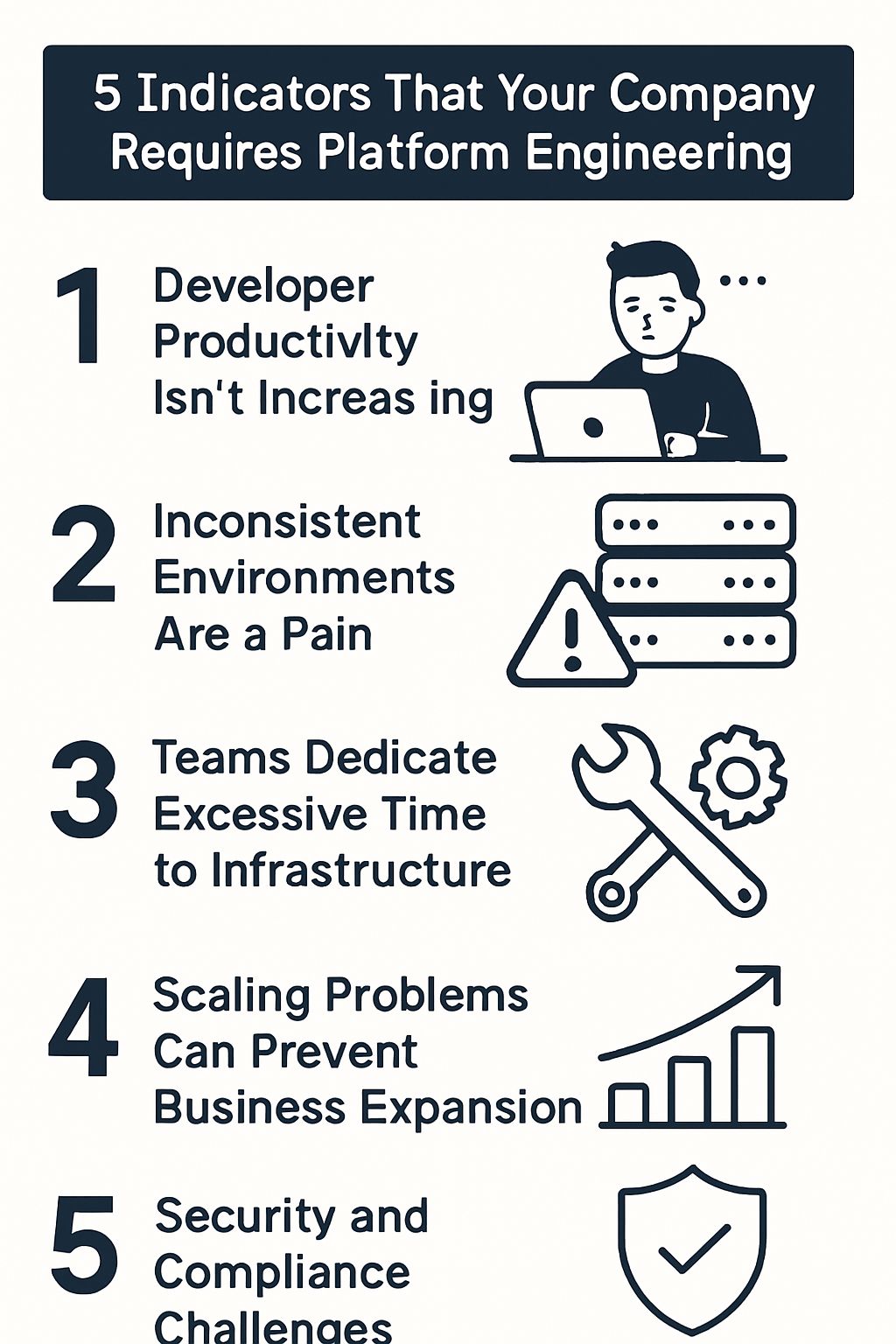
1. Developer Productivity Isn’t Increasing
When development teams are spending more time dealing with infrastructure and deployment processes than building features, it’s a clear sign that platform engineering could be beneficial. If engineers are reporting that they spend over 30% of their time on non-development tasks, it often indicates infrastructure friction that a dedicated platform could alleviate. This loss in productivity directly affects business outcomes by slowing down delivery and reducing the time available for innovation.
2. Inconsistent Environments Are a Pain
When you hear the phrase “it works on my machine,” you’re dealing with environment inconsistency. Platform engineering steps in to standardize the process. When teams are always dealing with differences between development, testing, and production environments, the quality goes down and debugging becomes unnecessarily complicated. Platform engineering takes care of this by creating environments that are consistent and reproducible across the entire development lifecycle.
3. Teams Dedicate Excessive Time to Infrastructure
When many teams tackle the same infrastructure problems individually, companies squander resources through repeated efforts. This issue typically appears as each team keeping their own deployment scripts, monitoring solutions, and infrastructure configurations. Platform engineering consolidates these shared needs into common solutions, enabling development teams to concentrate on their distinct business problems instead of recreating infrastructure wheels.
4. Scaling Problems Can Prevent Business Expansion
When companies expand, manual methods and makeshift solutions that were effective for small groups become unmanageable obstacles. If your operations team is slowing down the speed at which you can launch new services or increase the size of existing ones, platform engineering can assist by automating infrastructure provision and creating self-service features that do not necessitate direct operations participation. This ability becomes more and more crucial as companies embrace microservices architectures with dozens or hundreds of independent services.
5. Security and Compliance Challenges
When security and compliance requirements aren’t consistently met across teams, organizations can face serious risks and audit complications. Platform engineering can help by building security controls directly into the platform, ensuring that all applications are consistently secure. This “shift left” approach integrates security into the development workflow, rather than treating it as a separate issue. For more insights on security, explore our guide on Kubernetes for security compliance. This not only improves security, but also boosts developer productivity.
Constructing a Successful Platform Engineering Team
Building a successful platform engineering team demands careful contemplation of roles, structure, and talent acquisition. The best platform teams marry technical excellence with strong product thinking and empathy for developer needs. Constructing this team is arguably the most crucial factor in platform engineering success.
Before forming a team, businesses should have a clear understanding of the platform’s focus and goals. Will it mainly concentrate on deployment automation, or will it cover the whole developer experience from local development to production monitoring? The definition of this scope influences the makeup and skills required for the team.
Key Positions and Abilities
Efficient platform groups usually consist of a few critical positions: Platform Engineers, who create and uphold vital infrastructure elements, Developer Experience (DX) Engineers, who concentrate on user-friendliness and developer workflows, Site Reliability Engineers (SREs), who safeguard platform dependability and performance, and Product Managers, who collect requirements and prioritize platform features according to developer necessities. These positions necessitate a mix of technical abilities, such as infrastructure automation, API design, and observability, as well as soft skills like empathy, communication, and product thinking.
Possible Team Structures
Companies usually opt for either a centralized, federated, or hybrid structure for their platform team. A centralized team offers uniformity and effectiveness but may become a hindrance as the company grows. Federated structures divide platform duties among several teams, which enhances flexibility but may lead to inconsistencies. A lot of companies are successful with hybrid structures, where they have a main platform team that sets the standards and constructs common elements, while platform engineers are integrated within product teams to cater to domain-specific requirements.
How to Spot the Perfect Platform Engineers
Platform engineers who are worth their salt are those who not only possess a profound understanding of the technical aspects of the job, but also have a strong sense of empathy towards their customers and a knack for product thinking. When you’re on the hunt for the perfect candidate, make sure to look for those who have experience in the full stack and are familiar with both the development and operations side of things. The best candidates usually have a background in DevOps, site reliability engineering, or full-stack development, and they have a proven track record of automating infrastructure and enhancing developer workflows. But it’s not all about the technical skills – you should also be on the lookout for candidates who are genuinely interested in what developers need and have a service-oriented mindset.
7 Best Practices for Platform Engineering That Actually Work
Platform engineering applications may differ depending on the requirements of the organization, but there are a few practices that have consistently led to success. These best practices aid platform teams in providing the most value to their developer clients while avoiding typical mistakes that result in underused platforms or misplaced investments.
The most effective platform teams see their tasks from a product perspective, constantly concentrating on developer experience while constantly measuring and optimizing their services. They understand that platform adoption is not compulsory but is earned, and they create their services accordingly.
1. Embrace a Product Mentality
The most effective platform engineering projects view their platforms as products and developers as clients. This involves utilizing product management concepts like comprehending user requirements, ranking features based on their effect, and constantly revising based on input. Platform teams, like product teams, should perform routine user research, keep a prioritized roadmap, and track adoption and satisfaction.
This change in thinking drastically alters the way platform teams function. Rather than creating what they believe developers require, they interact directly with development teams to comprehend their difficulties and workflow obstacles. This developer-focused approach results in platforms that developers genuinely want to use, as opposed to tools they feel compelled to use.
Keep in mind that platform adoption is gained through an excellent developer experience, not through enforced policy. Developers will naturally be drawn to tools that make their work easier, more dependable, and more enjoyable.
2. Prioritize the Developer Experience
Platform engineering teams should prioritize developer experience (DX) above all else. This involves creating user-friendly interfaces, supplying easy-to-understand documentation, and reducing any unnecessary steps in the developer workflow. The platform should be designed to improve productivity, not create additional administrative tasks. It should make the correct methods (those that are secure, compliant, and efficient) the simplest ones to follow.
Take time to comprehend the process a developer goes through from start to finish. Identify any obstacles or mental blocks that could potentially slow down a developer or cause them to lose focus. Then, focus on improving these experiences, knowing that even the smallest changes in daily routines can greatly improve productivity when applied to all developers.
Think about hiring Developer Experience Engineers who concentrate on usability, documentation, and developer adoption. These team members are advocates for developers and help transform technical capabilities into user-friendly interfaces.
3. Automate Everything You Can
Automation is the key to successful platform engineering. Find tasks that are repeated throughout the development cycle—from provisioning environments to testing to deployment—and automate them systematically. This will reduce the amount of manual work for both developers and operations teams, allowing them to concentrate on more important tasks.
Begin by charting current processes and pinpointing manual tasks that could potentially be automated. Rank automation tasks based on how often they’re performed (frequency) and how much time they take up (impact). Initially, concentrate on tasks that are performed frequently and have a high impact to achieve immediate productivity improvements.
Keep in mind that automation isn’t only for speed—it’s also for consistency and dependability. Automated processes remove the variability and potential for error that come with manual steps, resulting in more predictable results and fewer production incidents.
4. Construct for Self-Service
For the benefits of the platform to be scaled throughout the organization, self-service capabilities are necessary. Developers should be able to provision environments, deploy applications, and troubleshoot problems without having to file tickets or wait for help from the operations team. This independence speeds up development and lowers operational costs.
Successful self-service requires a combination of technical automation and purposeful interface design. APIs and CLIs are great for integration and automation, and well-designed web interfaces allow occasional users to access capabilities. The best platforms support multiple interfaces for different user personas and use cases.
Strive for a balance between self-service flexibility and the necessary guardrails that ensure security and compliance. Instead of imposing strict constraints that hamper productivity, design systems that allow developers to have freedom within set boundaries.
5. Use Progressive Delivery
Progressive delivery methods such as feature flags, canary releases, and blue-green deployments should be integrated into the platform. These features allow teams to deploy more often and with less risk by managing feature exposure and allowing quick rollbacks when problems arise.
By offering these techniques as platform capabilities, companies can standardize deployment practices without forcing each team to implement them independently. This approach allows teams to have the flexibility to release features in a way that suits them best. This method combines the benefits of standardization with the autonomy teams need to adopt practices that suit their specific needs.
Platform engineering also makes it easier to experiment with new features in production by providing progressive delivery capabilities. This not only promotes innovation but also maintains system stability, striking a crucial balance.
6. Make Sure Your Documentation is Clear
For platform adoption, it’s crucial to have thorough, easy-to-understand documentation. Don’t just document how to use platform capabilities, but also the principles and best practices behind them. The best documentation combines reference materials (like API docs and configuration options) with conceptual guides and practical tutorials that help developers apply capabilities to real-world situations.
Think about using a documentation-as-code method, where the documentation is stored with the platform code in version control. This keeps the documentation up to date as the platform changes and makes it easier for team members to contribute. Tools like Backstage, which was developed by Spotify, offer great frameworks for building developer portals that merge documentation with self-service capabilities.
Keep in mind that documentation is not just about the written materials—it also encompasses inline help, CLI assistance, and intuitive interfaces that guide users through complex processes. The best platforms make documentation a part of the user experience rather than a separate resource.
7. Keep Tabs on Your Progress and Make Improvements
Keep track of important metrics that show how well your platform is doing and how it’s affecting the productivity of your development team. Keep an eye on technical metrics such as how often you deploy, how long it takes for changes to go live, and how often changes fail. You should also monitor user-focused metrics such as how satisfied your developers are and how many people are using your platform. This data will give you a clear, unbiased view of how well your platform is doing and show you where you need to make improvements.
Establish feedback loops that collect both numerical data and subjective insights from developers. Routine surveys, user interviews, and usage analytics assist platform teams in comprehending how developers engage with the platform and pinpoint friction points that require attention. This constant feedback loop ensures that the platform adapts to meet the changing needs of developers.
Be open about these metrics, communicating both the victories and areas that need work to stakeholders and users. This openness fosters trust and shows the platform team’s dedication to ongoing improvement.
Popular Tools and Technologies in Platform Engineering
The tools you choose to use in platform engineering will largely depend on what your organization needs and what technology stacks you already have. However, there are a few categories of tools that are the backbone of platform engineering today. The most successful platform teams are less concerned with the specific tools they’re using and more focused on creating integrated experiences that solve the problems developers are facing.
Tools for Infrastructure as Code
Teams use Infrastructure as Code (IaC) tools like Terraform, AWS CloudFormation, and Pulumi to define infrastructure through declarative configuration files, instead of using manual processes. These tools are a key part of platform engineering. They let teams create infrastructure that can be reproduced and version-controlled, and that can be provisioned automatically. The best platform teams build higher-level abstractions on top of these tools. This allows developers to provision standardized infrastructure without having to write complex configuration files themselves.
Understanding Kubernetes and Container Orchestration
When it comes to container orchestration, Kubernetes is the go-to solution. It offers a uniform platform for launching and managing containerized applications. To make Kubernetes more user-friendly for developers, platform teams often build extra abstractions on top of it. They use tools like Helm for package management, Kustomize for configuration management, and operator patterns for managing the lifecycle of applications. These tools enable platform teams to create interfaces to Kubernetes capabilities that are easier for developers to use.
Continuous Integration/Continuous Delivery Platforms
Continuous Integration/Continuous Delivery (CI/CD) platforms are automated systems that handle the testing and deployment process. This allows for frequent, dependable software releases. Platforms like Jenkins, GitHub Actions, GitLab CI, and CircleCI are commonly used as the basis for automated software delivery pipelines. Platform teams often create a standardized approach to CI/CD, which includes creating templates and reusable workflows. These workflows follow organizational best practices, but still allow individual teams to have flexibility based on their specific needs.
Service Mesh Solutions
Service mesh technologies like Istio, Linkerd, and Consul manage service-to-service communication within microservices architectures. They provide critical capabilities including traffic management, security, and observability. Platform teams implement service mesh solutions to provide consistent networking, security, and observability capabilities across all services without requiring individual teams to implement these concerns themselves.
It’s more crucial to incorporate these tools into a single platform than it is to choose specific technologies. The best platforms provide integrated experiences that address end-to-end developer workflows, rather than forcing developers to work with disjointed tools.
The Road to Platform Engineering
Platform engineering is not a destination, but a journey. It requires careful planning and a step-by-step approach. Companies should see this change as a slow evolution rather than a sudden revolution. They should start with the basics and then broaden their scope based on what their developers need and what the organization’s priorities are.
Start at the Beginning, But Keep the End in Mind
Start with a well-defined scope that tackles the biggest issues while still being achievable. Many organizations begin with deployment automation, creating standardized pipelines that make the path to production easier. This targeted approach provides immediate value while establishing the credibility of the platform team.
Begin with a small-scale approach, but also develop a long-term vision that takes into account how the platform will evolve to address the complete developer experience. Map potential capabilities against the software development lifecycle, from local development through testing, deployment, and operations. This vision will guide incremental investments while ensuring individual initiatives contribute to a coherent overall platform.
Get Quick Victories
Find improvements that are high-impact and achievable, and that show the value of the platform quickly. Look for shared problems that affect many teams and could be solved with standardized solutions. Automating deployment, provisioning environments, and managing secrets are often good places to start that provide immediate benefits to productivity.
Work closely with open-minded development teams who are happy to offer feedback and support the initial platform capabilities. These early users can help to fine-tune the platform’s offerings and show other teams the value it can bring, which helps to build momentum for wider adoption. Their success stories can be used as compelling proof when trying to convince more cautious teams to use the platform.
Make sure to record and applaud these initial victories, measuring both technical enhancements (how often you deploy, lead time) and business effects (quicker delivery of features, fewer outages). These success stories encourage further investment in the platform.
Grow Incrementally
As more and more people start using the platform, increase its capabilities based on the feedback from the developers and the priorities of the organization. Focus on features that solve common problems across several teams, making the most of the platform’s investments. As the platform evolves, this could involve adding capabilities such as observability, performance testing, or security scanning.
Think about how the team structure will change as the platform grows. Lots of organizations start with a small team that’s all in one place, and then move to a hub-and-spoke model. That’s where the main platform capabilities are kept in one central place, while platform engineers who are part of the product teams develop extensions that are specific to their domain.
As you scale, never lose sight of the developer experience. Even as the platform grows in capabilities, it should still feel like a unified, easy-to-use tool rather than a disjointed set of utilities. Regular user research and feedback sessions are a great way to spot opportunities for better integration and to tackle usability issues.
Platform Engineering Success Stories in the Real World
Looking at how top organizations have used platform engineering gives us important insights into what works and what doesn’t. While the specifics can vary depending on the organization, there are common trends in successful platform engineering projects.
The Creation of Netflix’s Developer Platform
Netflix’s approach to platform engineering was to create a “paved path” that makes it easy for developers to build services that adhere to best practices. Their platform simplifies infrastructure while offering robust tools for deployment, testing, and monitoring. Instead of making teams use these tools, Netflix made them so beneficial that teams naturally select them over other options.
One of the main takeaways from Netflix’s strategy is their focus on developer productivity as the main metric. They consistently evaluate how the platform influences the speed of development and give priority to features that eliminate obstacles in developer workflows. This unwavering concentration on the developer experience has led to a platform that can handle thousands of microservices while keeping developer satisfaction high.
Spotify’s Backstage Journey
Spotify developed Backstage to function as an open-source developer portal that solves fragmentation in their internal tools ecosystem. As their microservices architecture expanded, teams had difficulties finding and using the abundance of tools and services. Backstage offers a unified interface where developers can locate documentation, create new services from templates, and use a variety of internal tools.
Spotify’s strategy highlights the significance of exploration and uniformity in extensive engineering firms. They made existing features more approachable by establishing a central developer portal and provided a uniform experience across various tools. Their choice to make Backstage open-source has led to a dynamic ecosystem of plugins and extensions that improve platform features even more.
Ensuring Your Platform Engineering Strategy Stays Relevant
As the world of technology continues to change and grow, platform engineering strategies must change and grow with it to stay relevant. In the near future, there are several trends that are likely to affect platform engineering, including more integration of AI, a greater emphasis on automating security, and a move towards platform ecosystems rather than one-size-fits-all platforms. Companies need to make sure their platform strategies are flexible enough to include these up-and-coming capabilities.
When it comes to platform strategies, the best ones are those that focus on creating flexible foundations. These strategies are not tied to specific technologies, but rather are adaptable. By focusing on APIs, modularity, and extensibility, platform teams can gradually update their offerings as technologies change and new capabilities emerge. This approach ensures that the platform continues to be relevant and valuable, even as the underlying technologies change.
Commonly Asked Questions
Companies that are thinking about starting platform engineering projects usually have a few questions that come up often about how to put it into action, how much it will cost, and what benefits they can expect to see. Answering these questions from the start helps everyone in the organization get on the same page and have a clear idea of what they can expect from platform engineering.
While these responses are informed by industry experience and can serve as a general guide, individual situations may differ due to the specific context of the organization, the existing technological environment, and the particular objectives at hand.
What is the cost of platform engineering implementation?
The cost of implementing platform engineering can be quite different from one organization to another. It depends on factors such as the size of the organization, the existing infrastructure, and the scope of the platform. The initial investment often includes a dedicated platform team (usually 3-8 engineers for midsize organizations), the cost of licensing the tools, and possibly consulting expenses. Costs can be cut drastically by outsourcing the dedicated platform responsibilities to companies like SlickFinch. Most organizations start to see a positive ROI within 9-12 months, thanks to improved developer productivity, fewer operational incidents, and a faster time-to-market. Instead of seeing platform engineering as a cost center, think of it as an investment in engineering efficiency that provides ongoing returns through improved productivity.
Is platform engineering beneficial to small businesses?
Definitely, even small businesses can benefit from the principles of platform engineering, although the application may vary from large-scale business methods. Small teams should concentrate on simple automations and standardized processes rather than creating all-inclusive platforms. Begin with the most challenging areas in your development process, such as deployment automation or environment provisioning. As the business expands, these initial investments evolve into the basis for more all-inclusive platform capabilities.
What capabilities do platform engineers need to possess?
Successful platform engineers are a unique blend of broad technical knowledge, excellent communication, and empathy. They should have technical skills in areas such as infrastructure automation, API design, cloud services, CI/CD implementation, and fundamental security practices. Soft skills are just as crucial, with developer empathy, product thinking, technical writing, and collaboration being key. The most effective platform engineers not only understand the technical aspects of implementing a platform, but also how these decisions will impact the developer’s experience.
When can you expect to see ROI from platform engineering?
For most companies, measurable benefits start to appear within 3-6 months of starting platform engineering projects, with full ROI usually realized within 9-12 months. Early victories often come from automating deployment and standardizing environments, which immediately boost productivity. As the platform grows to cover more of the development lifecycle and more teams start using platform features, the benefits continue to accumulate over the long term.
It’s important to monitor both leading indicators, such as platform adoption and developer satisfaction, and lagging indicators, like deployment frequency and lead time for changes, in order to gauge the impact of the platform. These metrics are useful for showing value and helping to make decisions about future investments.
Is it better to create our own internal developer platform or purchase one?
This really depends on the skills of the team you have available in-house. Many companies opt for a combination of the two, creating custom integrations on top of commercial or open-source components. They often use existing tools for key capabilities like CI/CD, infrastructure management, and observability, while the integration layer and developer interfaces may be custom-built to accommodate specific organizational workflows. Many other companies choose to outsource the entire platform managmeent side to consultants like SlickFinch who will custom build and maintain your platform for you, saving you the need for a lengthy and difficult hiring process whilst also allowing your team to reap the benefits.
When you’re deciding whether to build, buy, or outsource, you need to think about things like what exactly you need, the skills your team has, how much it’ll cost to keep things running, and whether you’re okay with being tied to one vendor. And no matter whether you build something yourself or get it from somewhere else, you need to make sure it fits in well with everything else your developers are working with.
Don’t forget, the objective isn’t to build a platform just for the sake of it, but to address the issues developers face and enhance their productivity. Keep your focus on the results, rather than on specific ways to implement them.
- Identify a clear platform scope and objectives that align with the organization’s priorities
- Begin with high-impact, achievable improvements that show immediate value
- View developers as customers, prioritize their experience and collect regular feedback
- Measure platform impact using both technical metrics and developer satisfaction
- Balance standardization with flexibility, provide paved paths but allow deviation when necessary
Platform engineering is a major evolution in how organizations approach development infrastructure. By creating standardized, self-service capabilities that abstract complexity while maintaining necessary governance, platform teams allow developers to focus on creating business value rather than dealing with infrastructure concerns.
Are you prepared to embark on your platform engineering adventure? SlickFinch offers a complete platform engineering solution that merges the advantages of a self-service developer experience with the control and observability of an enterprise-grade solution. Discover how our platform can expedite your engineering transformation without the expense of constructing everything from the ground up.