
Main Points
-
A well-built Internal Developer Platform (IDP) can cut down onboarding time by up to 73% and significantly increase development speed
-
Start with platform capabilities that address actual developer issues rather than building a portal first
-
Your first IDP iteration should concentrate on creating one "golden path" that provides immediate value
-
The discovery phase (Days 1-30) is crucial for identifying the correct workflows to automate and obtaining stakeholder approval
-
Experience from SlickFinch shows that organizations that implement IDPs following a structured roadmap see adoption rates 5x faster than ad-hoc approaches
Constructing an Internal Developer Platform doesn't have to be a daunting, year-long project. You can deliver substantial value to your engineering teams within just 90 days with the right approach and focused execution.
The field of platform engineering has grown by over 500% in the last three years. This is because it addresses the complexity that slows down developers. As a CTO, you are in a unique position to lead this organizational change. SlickFinch has helped many organizations successfully implement IDPs. We have used this experience to create this practical roadmap.
Let's take the idea of an Internal Developer Platform from theory to a tangible plan that you can start implementing right away.
The Importance of an Internal Developer Platform for Your Development Team
Today's development teams are dealing with complexity like never before. Between microservices, Kubernetes, cloud-native tools, and the constantly growing ecosystem of development technologies, it's easy for your engineers to become overwhelmed. Instead of focusing on building features that drive business value, they're spending too much time grappling with infrastructure.
Statistics paint a vivid picture. Companies that have put IDPs into action report a 73% quicker onboarding process for new developers and significant enhancements in the speed of development. What's even more impressive is that they see massive decreases in context-switching and cognitive load - the unseen productivity destroyers in today's development environments.
"Before we had an IDP, we were only deploying once every two weeks. Now, six months after we started using it, we're deploying 15 times per day and we're having fewer incidents. The platform paid for itself within the first quarter." — VP of Engineering at a Fortune 500 financial services company
An IDP isn't just another tool - it's a strategic investment in developer productivity. It creates standardized, self-service capabilities that empower developers while maintaining the governance and security your organization requires. The result is faster delivery, higher quality, and more satisfied engineering teams. For more on this concept, explore platform engineering best practices.
Setting the Stage: The Core Components of an Authentic Internal Developer Platform
Before we delve into how to implement it, it's crucial to understand what exactly an Internal Developer Platform is. Many companies mistakenly believe that an IDP is just a set of tools or a basic developer portal, but a genuine platform is much more than that. An IDP provides abstraction layers over intricate infrastructure and allows for self-service workflows that adhere to your organization's best practices.
The aim is to establish "golden paths," or standardized workflows that make the correct method of building and deploying applications the simplest method. This doesn't limit the freedom of developers; instead, it speeds up common tasks and reduces cognitive load.
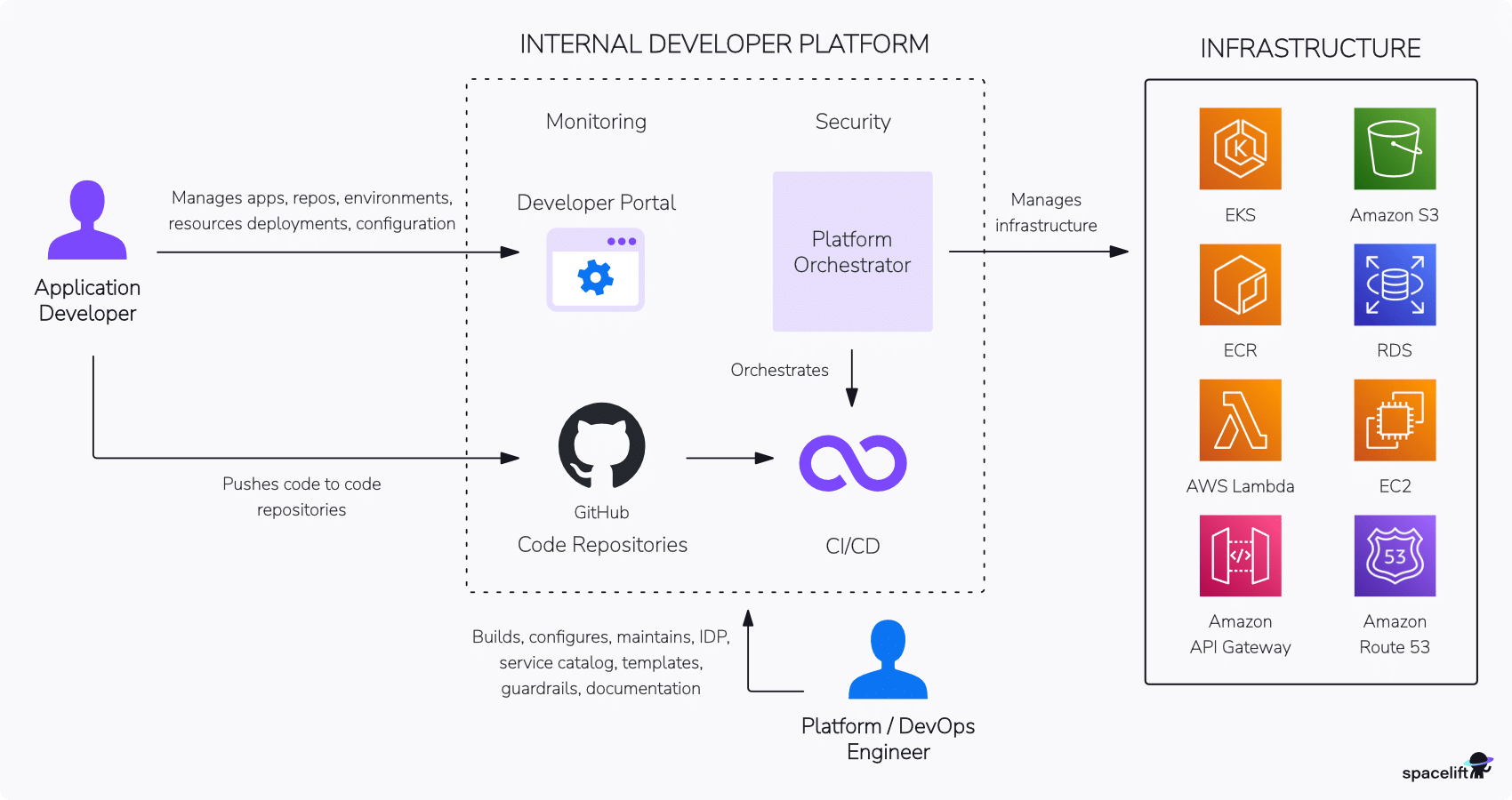
"Internal Developer Platforms (IDPs ..." from spacelift.io and used with no modifications.

Key Elements vs. Useful but Not Essential Features
When you first start to implement your IDP, you should concentrate on the key elements that will provide instant value. Many platform initiatives don't work out because they try to build everything at once, instead of starting with the key elements and then iterating.
-
Key elements: Automated infrastructure provisioning, application templates, environment management, and CI/CD integration
-
Additional functionalities: Developer portal UI, advanced observability, cost management, and policy enforcement
-
Potential improvements: AI-assisted operations, advanced compliance automation, and cross-team service discovery
The best IDPs start with a strong base that tackles particular issues, then develop based on genuine developer input. Avoid the urge to create everything at once.
Platform and Portal: What's the Difference?
Many IDP implementations fail because they begin with the portal - the user interface - rather than focusing on the capabilities of the underlying platform. A pretty UI with no powerful automation is nothing more than a dashboard that leads to frustration.
Your platform is made up of the APIs, automation, and integrations that enable self-service. The portal is just one way that developers can interact with these features. For your first implementation, concentrate on building strong platform features, even if they're accessed through command-line tools or basic web interfaces. After you've confirmed that your main workflows are working, you can add a more advanced portal.
Keep in mind that a good number of developers favor Command Line Interface tools over web interfaces for their daily tasks. Your platform should be able to support both interaction models, thus enabling developers to work in an environment where they are most productive.
Self-Service Features That Truly Make a Difference
While developer self-service is the core of a successful IDP, not all self-service features are equally beneficial. Prioritize automating the tasks that take up the most developer time and cause the most headaches.
Based on our work with hundreds of engineering organizations, we've found that the most effective self-service capabilities usually involve: environment provisioning that takes minutes instead of days, standardized application scaffolding that incorporates best practices, simplified access management, and streamlined deployment pipelines that enforce quality gates without manual intervention.
Top-tier self-service capabilities don’t merely automate existing processes. Instead, they reinvent workflows to completely remove any unnecessary complexity. This typically involves closely collaborating with both developers and operations teams to understand not just their current tasks, but also what would substantially simplify their work.
Days 1-30: Discovery and Design Phase
The first month of your IDP journey should be dedicated to discovery and design, not construction. This groundwork will decide whether your platform addresses actual issues or becomes just another underused tool. Understanding platform engineering best practices can significantly enhance this phase.
Identify Your Current Developer Workflows and Challenges
Start by outlining your current development workflows from conception to production. Speak with developers from various teams to pinpoint frequent issues and time-draining manual tasks. Search for trends in their feedback - these indicate your most significant chances for enhancement.
Develop a "developer journey map" that provides a comprehensive view of the entire process, emphasizing bottlenecks and periods of waiting. Focus on cross-team handoffs and approval processes that result in delays. These maps frequently show that developers only spend 30-40% of their time coding, while the rest is taken up by infrastructure, deployment, and operational tasks.
Whenever you can, measure the effect of these pain points. Keeping track of metrics such as "how long it takes to set up a new environment" or "the number of steps needed to implement a simple change" gives you valuable baseline data for assessing the future impact of your platform.
Find Your Initial Golden Path
A golden path is a routine, automated workflow that directs developers through a frequent task while adhering to your organization's best practices. Your initial golden path should aim for a high-frequency, high-friction workflow where automation can provide instant value.
Typical initial golden paths encompass: launching a basic web app, establishing a comprehensive development environment, or executing a database modification. The perfect candidate should be something that impacts the majority of developers frequently and presently necessitates numerous stages or team handoffs.
Record this ideal journey in depth, noting down the existing manual procedures, the intended automated result, and the exact platform capabilities needed. This description will serve as the plan for your initial platform implementation sprint.
Selecting the Appropriate Team Configuration
Platform engineering demands unique abilities and a product-focused mentality. Look for engineers who are familiar with infrastructure automation, API design, and developer experience. The most effective platform teams are those that merge infrastructure know-how with a comprehensive grasp of developer workflows.
Begin with a compact, specialized team - usually 3-5 engineers - who can concentrate solely on the platform. Attempting to construct an IDP as a side project in addition to regular development work is almost always unsuccessful. Make certain this team has immediate access to both development and operations stakeholders.
Think about appointing "platform champions" from different development teams who can give feedback, test preliminary versions, and assist in driving adoption. These champions become priceless advocates when you start deploying the platform on a larger scale.
Establishing Tangible Success Indicators
Identify precise, quantifiable results that will signal platform triumph. Eschew vague indicators such as "enhance developer efficiency" and instead opt for solid markers that can be gauged pre and post implementation.
Good metrics often include: decreasing the time it takes to set up environments (for example, from days to minutes), reducing the number of failed deployments, increasing the frequency of deployments, reducing the time it takes to onboard new developers, and reducing the number of support tickets related to infrastructure problems. Plan to measure both technical improvements and how satisfied developers are through regular surveys.
During your discovery phase, set a standard for these metrics. This information will be crucial for showing platform ROI to stakeholders and directing future enhancements.
Get Stakeholders On Board Early
Platform initiatives need backing from all corners of the organization. Pinpoint the key stakeholders from development, operations, security, and business leadership. Share the results of your discovery phase, highlighting the specific issues you've found and the measurable effect of resolving them.
Develop a succinct business case that underscores immediate victories and long-term strategic worth. For technical leaders, underscore efficiency and standardization. For business stakeholders, emphasize faster delivery and enhanced quality. For security and compliance teams, highlight how built-in safeguards will enhance governance.
Get a formal commitment for the first 90-day implementation and a long-term investment in platform development. The most successful IDP initiatives are seen as strategic abilities rather than one-off projects.
Days 31-60: Creating Your Basic Platform
After you've conducted your research and gained the support of your stakeholders, the following 30 days will be devoted to developing your platform's basic features. The aim is to create a Basic Viable Platform (BVP) that offers instant benefits through your first golden path while laying the groundwork for future growth.
Using GitOps for Infrastructure Management
GitOps is the backbone for declarative, version-controlled infrastructure that supports your platform. Set up a CI/CD pipeline that automatically applies infrastructure changes when code is merged to your specified branches. This gives you a single source of truth for your whole platform configuration and allows for effective collaboration patterns.
Choose tools that are compatible with your infrastructure environment - Flux or ArgoCD for setups based on Kubernetes, or Terraform Cloud for scenarios involving multiple clouds. Set up these tools to automatically bring your actual infrastructure in line with the state defined in your repositories. This guarantees consistency and eliminates configuration drift.
Establish distinct repositories for platform infrastructure, application templates, and environment configurations. This division permits proper access controls and change management procedures while preserving the GitOps workflow throughout.
Developing Your Initial App Template
App templates offer a uniformed starting point that includes your company's best practices. Create your initial template based on the type of application pinpointed in your golden path, which is usually a web service or microservice pattern frequently used in your company.
Not only should you include application code, but also complete pipeline configurations, infrastructure definitions, monitoring setup, and security controls. The goal is to provide developers with everything they need to create a production-ready service by answering a few simple questions. Tools such as Backstage, Yeoman, or custom templating solutions can make this process more efficient.
Make sure to include security and compliance requirements in your template from the beginning, making them built-in features rather than something you tack on at the end. This proactive approach saves you from having to do expensive rework and speeds up the time it takes to go into production.
Establishing Automated Environment Creation
One of the most common issues in development workflows is environment provisioning. Implement a self-service environment creation system that enables developers to create entire, isolated environments with a single command or click.
Make sure your provisioning system can create identical environments for development, testing, and production. Use infrastructure-as-code templates that can create the application infrastructure, databases, secrets, networking, and other dependencies. This will help you avoid the "works on my machine" issue that often comes up with manual environment setups.
Set up governance controls that maintain environment standards without the need for manual approvals. For instance, resource limits, security configurations, and cost controls should be automatically applied based on the type of environment, while still allowing developers the flexibility they require.
Setting Up Your CI/CD Pipeline
Your platform needs to offer standardized CI/CD pipelines that make deployment easier and enforce quality gates. Create pipeline templates that manage common workflows such as testing, security scanning, deployment strategies, and monitoring integration.
Set up these pipelines to work flawlessly with your application templates and environment provisioning. A developer should be able to trigger consistent deployments across all environments using the same pipeline, with environment-specific configurations automatically applied. This eliminates the "it worked in development but failed in production" scenario.
Make sure to integrate observability hooks into your pipelines that will automatically equip applications with monitoring, logging, and tracing. This will guarantee that all applications deployed through your platform offer consistent operational visibility without the need for developers to manually implement these capabilities.
Days 61-90: Expansion and Implementation
The last 30 days are devoted to launching your platform to real users, collecting their thoughts, and creating the necessary procedures for sustained growth. This stage is crucial - even the most well-designed platform will be unsuccessful if developers do not embrace it.
Launching with Your Test Group
Pick a test group that mirrors your intended users but is also willing to offer comprehensive feedback. Ideally, pick a group that is working on a fresh project or feature instead of one that is deep into a current development cycle. This gives them the chance to fully explore what the platform can do without the stress of having to shift old workflows in the middle of a project.
Hold interactive workshops that lead the pilot team through your initial golden path. Take note of their inquiries, points of misunderstanding, and recommendations. These workshops frequently uncover assumptions in your platform design that must be resolved prior to broader deployment.
Offer dedicated assistance during the trial period. Keep platform team members on standby for any quick questions or problem-solving. This direct interaction is priceless for identifying chances for improvement and for creating support for your platform.
Gathering Valuable Feedback
-
Establish a variety of feedback avenues, such as automatic surveys after significant platform interactions
-
Set up weekly retrospectives with trial users to discuss what's going well and what needs to be improved
-
Monitor platform usage statistics to identify which features are being used and which are being ignored
-
Develop a public roadmap that includes user feedback and displays upcoming enhancements
Organize feedback into immediate repairs, short-term upgrades, and long-term enhancements. Prioritize addressing crucial usability problems that hinder adoption, even if they appear minor from a technical standpoint. Keep in mind that the developer experience is crucial to platform success.
Openly share feedback with stakeholders to show that you're responsive and to build trust. When developers see that their input directly influences the platform's evolution, they become invested in its success instead of seeing it as something forced upon them.
Take advantage of the feedback to enhance your value proposition and adoption strategy. The reasons why developers actually adopt your platform can often be different from what you originally assumed. This knowledge is important for positioning your platform effectively during a wider rollout.
Keeping Records of Everything
It's crucial to have detailed documentation for the adoption and scalability of the platform. Make documentation that is easy to understand and explains how to use the platform and why certain methods are recommended. Include tutorials, reference materials, and troubleshooting guides that deal with common situations identified during your trial run.
Tracking Developer Experience Enhancements
Collect numerical data that compares your starting metrics to the results after implementation. Gauge the time saved, the reduction in errors, and the improvements in processes made possible by your platform. These tangible results will encourage further investment and growth.
Carry out subsequent developer surveys to measure shifts in satisfaction and productivity. Inquire about which platform capabilities have been the most beneficial and which areas are still causing issues. This qualitative feedback, along with your quantitative metrics, gives a comprehensive view of the platform's effect.
Share these findings with stakeholders in both technical and business language. When speaking to a technical audience, concentrate on specific workflow enhancements and adoption statistics. For business stakeholders, convert these into business results such as faster feature delivery, better quality, and resource efficiency.
Mapping Out Your Next Golden Path
Utilize feedback and usage data to pinpoint your next golden path opportunity. Try to find workflows that not only build on your current platform capabilities but also alleviate additional developer pain points. Popular second golden paths often involve database change management, feature flag implementation, or service mesh integration.
Common Mistakes When Implementing an IDP
Even with the best of intentions, many Internal Developer Platform projects don't live up to their potential. Knowing what the common mistakes are can help you avoid them and make sure your platform is successful in the long run.
The biggest pitfall is viewing your platform as a tech fix rather than a product. Successful platforms are developed with a product mindset - they are centered on user needs, constantly enhanced based on feedback, and aggressively promoted to boost adoption. Platform teams that function like traditional infrastructure teams frequently create technically sophisticated features that developers simply ignore.
Another common mistake is trying to do too much at once. Companies that try to fix all developer issues at the same time often end up with platforms that are too complex, take too long to put into place, and overwhelm the people using them. The step-by-step approach in this roadmap - focusing on one main path at a time - significantly improves how many people adopt the platform and the return on investment.
Here are some common mistakes to avoid:
-
Designing a visually appealing portal without enough automation underneath
-
Not securing executive sponsorship for long-term platform investment
-
Designing inflexible workflows that don't accommodate legitimate exceptions
-
Measuring platform success by features delivered rather than developer adoption
-
Underestimating the organizational change management required
Perhaps the most dangerous pitfall is the "if we build it, they will come" mentality. Even the best-designed platform requires intentional change management, internal marketing, and ongoing support to drive adoption. Your rollout strategy is just as important as your technical implementation.
Begin with the Platform, Not the Portal
One common error is to focus on creating a visually appealing developer portal UI before putting in place the underlying platform capabilities that provide genuine value. This approach frequently results in a visually stunning but superficial experience that irritates developers when they discover that the portal does not actually address their issues. Instead, concentrate on automating key workflows first, even if the initial interface is command-line based or minimalist. You can gradually improve the user experience as you confirm that your core capabilities are delivering value.
Resist the Urge to Overcomplicate Your First Version
It's easy to get caught up in the idea of creating a platform with all the bells and whistles right out of the gate. However, trying to do too much in your first iteration often results in missed deadlines, unnecessary features, and lackluster user adoption. Instead, adopt a true minimum viable platform mindset. Concentrate solely on the capabilities needed for your first golden path, even if they seem rudimentary compared to your grand vision. Keep in mind that a straightforward platform that effectively addresses one problem will be more successful than a complex system that only partially addresses multiple problems.
Research has repeatedly demonstrated that platform teams who deliver value in small increments every 2-4 weeks are able to keep stakeholders and developers engaged. Teams that go off the radar for six months to build the "ultimate" platform usually find that requirements have changed, interest has faded, or alternative solutions have popped up while they were gone. The process of build, release, get feedback, and iterate significantly boosts your chances of success.
Without Clear Ownership, Your Platform Will Fall Apart
If you don't establish clear ownership from the start, your Internal Developer Platform will quickly become an outdated, unmaintained system. You need to have dedicated resources that are committed to the ongoing development, support, and evolution of the platform. The most successful IDPs are the ones that are owned by dedicated platform engineering teams. These teams treat the platform as their product and the developers as their customers. This product-minded approach ensures that the platform will continue to evolve to meet the changing needs of the developers. It will not just stagnate after it is initially released.
Developing Your IDP
Your 90-day implementation period is just the first step of your platform journey. The best IDPs are constantly changing based on developer feedback, organizational needs, and technological advancements. If you plan for this evolution from the beginning, you can ensure your platform stays valuable and relevant instead of turning into technical debt.
Develop a roadmap that spans 12-18 months, which balances the introduction of new features with the improvement of existing ones. This roadmap should be shared openly with stakeholders and users to manage expectations and gather input on what should be prioritized. Your roadmap should be organized around specific developer journeys and outcomes, rather than technical features. This approach, which is user-centric, ensures that your platform remains focused on delivering tangible value, rather than pursuing the latest technological trends.
Adding a Developer Portal: When and How
After you have established and adopted your main platform capabilities, you can greatly improve discoverability and usability by adding a developer portal. A well-structured portal acts as the gateway to your platform, allowing developers to easily find available services, templates, environments, and documentation. You should consider adding a portal once you have at least 2-3 golden paths that are established and stable, which is usually 6-9 months into your platform journey.
Growing Your Golden Paths
As your platform continues to develop, you should strategically add new golden paths that cater to more developer workflows. The paths you add should be prioritized based on how often they are used, how much they are currently needed, and how important they are to your overall strategy. Each new path you add should not only build on your platform’s existing capabilities but also expand them in a targeted manner. This gradual expansion helps to keep the scope of your platform manageable while also continuously increasing its value.
Cultivating a Culture of Platform Engineering
To ensure the long-term success of your platform, it’s crucial to foster a platform engineering culture that sees the developer experience as a strategic advantage. Encourage those on your platform team to develop a deep understanding of the needs of developers, to maintain a high level of technical excellence, and to strike a balance between standardization and flexibility. Celebrate the achievements of your platform, but also the successful products that have been built on it. This double recognition underlines the fact that your platform is there to empower development teams, not to restrict them.
Common Questions
When you start building your Internal Developer Platform, you're bound to get questions from people throughout your company. Here are data-driven answers to the questions we hear most often when we're helping companies build their first platform.
What's the cost for our first IDP implementation?
For a typical 90-day MVP implementation, you should plan for 3-5 dedicated engineers plus infrastructure costs. Most companies use existing infrastructure at first, so the main cost is the time of the engineers. The total cost usually ranges from $150,000 to $300,000 for the first implementation, depending on your market and whether you use existing tools or create custom solutions. This is what puts a lot of companies off from implementing an IDP. With a partner like SlickFinch, you can completely offload all of this work for a fraction of the cost of trying to implement it yourself.
The return on investment then becomes obvious when you consider the impact on productivity across your entire engineering team. Companies that have implemented IDPs typically report a 20-30% increase in developer productivity. This translates to substantial returns for organizations with even small engineering teams.
Do we need to start from zero or can we use what's already out there?
Most of the time, the best way to go is a mix of both. You can use what's already been made, like Backstage, Argo, Crossplane, or even commercial products, and add your own custom layers. This way, you can get your platform up and running faster, and you can spend more time making it work for your specific needs. The most important thing is to make sure it's easy for your developers to use, no matter how complicated it might be behind the scenes.
Stay away from the two extremes: creating everything from scratch (which significantly lengthens the time it takes to get value) or just throwing together various tools without proper integration (which results in a disjointed developer experience). The most successful platforms carefully mix the best tools with specific custom development to create a smooth, cohesive experience. SlickFinch have extensive experience in building IDPs and can take the headaches of knowing what the best choice is off your hands.
How many engineers should we allocate to our platform team?
For the first phase of implementation, a dedicated team of 3-5 engineers with a balanced combination of infrastructure, automation, and developer experience skills is usually enough. This team should be completely concentrated on the platform, rather than dividing their time with other tasks. For the maintenance and development phase, a rough rule of thumb is to have one platform engineer for every 40-50 application developers supported.
The makeup of your platform team is as crucial as its size. Seek out engineers who possess a potent blend of technical skills, an understanding of developer needs, and a product mentality. Often, the most effective platform engineers are those who have felt the frustration of inadequate developer workflows and are eager to address these issues, but any of these engineers can be hard to find if you don't already have them available on your team. For less than the cost of a single engineer, SlickFinch can maintain and manage your entire portal for you, leaving your existing team to focus on other work.
What are the key metrics to track IDP success?
Operational metrics, developer experience metrics, and business impact indicators are the three main types of metrics that can help you measure the success of your IDP. Operational metrics can help you track improvements in efficiency that your platform enables, such as reducing the time it takes to provision environments, increasing the frequency of deployment, and decreasing the lead time for changes.
Metrics for the developer experience evaluate how the platform impacts developer happiness and efficiency. These metrics incorporate rates of adoption, scores for developer satisfaction, time saved from less context-switching, and shorter onboarding times for new team members.
Metrics that measure the business impact turn technical enhancements into company results. These usually involve faster feature delivery times, better quality (measured by fewer defects and incidents), and more effective use of resources. The most persuasive business cases combine all three types of metrics to show the complete value of the platform.
-
How long it takes for new developers to make their first deployment (measuring the efficiency of onboarding)
-
How often teams are deploying (measuring delivery speed)
-
How often changes fail (measuring the impact on quality)
-
The average time it takes to recover (measuring operational resilience)
-
The Developer Net Promoter Score for platform capabilities (measuring satisfaction)
Is it possible to implement an IDP in a hybrid cloud environment?
Yes, Internal Developer Platforms are especially useful in hybrid and multi-cloud environments because they can simplify the underlying complexity. The key is to design your platform architecture with the right abstraction layers that protect developers from the specifics of where workloads run while maintaining consistent workflows across environments.
Adopt infrastructure-as-code practices that can handle multiple target environments with environment-specific configurations managed through a unified system. Tools such as advanced Terraform implementations, Crossplane, or Pulumi can offer the required abstraction while preserving environment-specific optimizations.
Make sure to keep security and compliance in mind, as hybrid environments often have unique requirements across environments. Your platform should include these requirements as built-in features, not as an afterthought, to ensure consistent governance without overloading developers with procedures specific to the environment.
Most companies start their journey to IDP by standardizing workflows in one environment and then slowly expanding to support hybrid scenarios as the platform develops. This step-by-step method lessens the initial complexity while laying the groundwork for a comprehensive solution that spans multiple environments.
Creating your first Internal Developer Platform is a significant undertaking that requires a lot of dedication and planning. However, the payoff can be transformative for your engineering organization. By adhering to this 90-day roadmap and keeping the needs of your developers front and center throughout the process, you'll establish a sustainable acceleration of delivery that can grow with your organization.
At SlickFinch, our primary focus is to guide companies through successful platform engineering transformations that offer tangible improvements in developer productivity and software delivery performance. Get in touch with us to find out how we can help you navigate your platform journey with confidence.